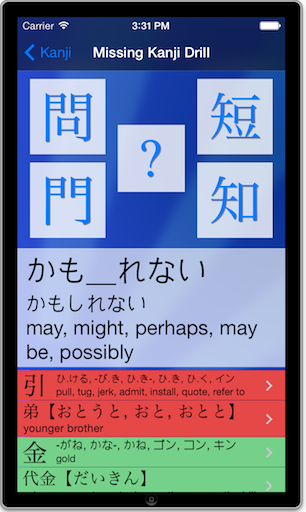
Version 1.4 of KanjiBox brought KanjiDraw, version 1.5 is bringing KanaDraw (among many other cool and exciting features).
These two features add a completely new dimension to KanjiBox, allowing you to improve something at the heart of Japanese studies (and, until now, extremely hard to practice without a real teacher): handwriting!
Like most Japanese students (me included), you probably barely ever need to write Japanese by hand. The ubiquitous use of phones/computers/etc. makes it nearly redundant. And yet, knowing how to properly write by hand is much more important than it may originally seem:
- A perfect master of kana is obviously crucial. Without it, you are functionally illiterate in Japan, unable to properly fill-in any form or other piece of administrative paper that fills your daily life.
- Aside from the obvious direct use of knowing how to write kanji and kana, knowing how to write them, having paid attention to ever single stroke, will dramatically improve your ability to read and remember them. You cannot hope to go beyond a certain level of Japanese without a working knowledge of stroke order (useful for lookups) and kanji sub-radicals: it is all too easy to learn a few hundred kanji by memorising their overall aspect (and not really paying attention to their radicals), but it will come and bite you in the arse when you start learning more and more complex variations.
Both KanjiBox and KanjiDraw use even more complex algorithms than the original Drill&Quiz methods to analyse your strokes and propose custom corrections. They are extremely strict on the stroke order (no way around that), but allow a fair bit of leeway on the shapes etc., in order to make up for the difficulty of tracing the characters with a finger on a touchscreen. The difficulty (including the level of strictness) goes increasing with your performance.
Of course, these new modes use the same adaptive learning algorithm used by all other parts of KanjiBox, meaning that entries are automatically selected on the basis of how well your past performances have been.
Have fun with these new features and don’t hesitate to leave your impressions here or contact me directly…